

Articles
Role play ideas for couples at a beginner level

Nov
Last updated: November 2, 2026.
Quick summary
For couples who are just starting out, role play ideas are best started with short, simple scenes, such as a nurse and a patient, a strict teacher and a stubborn student, or strangers on a train. Before you try anything, talk about boundaries and a safe word.
- To start, 10-minute, simple scene sketches are best.
- Before you come up with anything, discuss boundaries and consent.
- Choose a safe word that can be used to stop the game immediately.
- A neutral mask and a simple accessory are enough to get started.
- After the game, discuss what you liked and what you would do differently.
Table of contents
- Why is role-playing good for beginners?
- Before you make up anything: talk about boundaries and consent
- Short role-playing ideas for beginners
- Role-playing scenarios for couples step by step
- Role-playing supplies for couples: what do you really need?
- What if one of you gets embarrassed or changes your mind?
- Next step: choose an evening and an idea
- Frequently asked questions
Role play ideas for couples at the beginner level? It's a great topic, and we're glad you're exploring it. The answer is simple: take small steps, and always make sure you both have fun.
Why is role-playing good for beginners?
Role-playing works well for couples who are just starting out because it doesn't require much preparation. A role, some clothing, and a good mood are all you need to discover a new side of yourself.
Mostly this is what makes it exciting:
- It breaks you out of your usual routine. The same bedroom will be different if someone else plays the role.
- It's easier to talk about desires. It's often easier to say what you want through a role.
- There is less pressure. If it's just a game, no one has to be perfect.
If you're just starting out, don't try to create a complex scene right away. The best first step is a short, easy-to-follow idea.
Before you make up anything: talk about boundaries and consent
This part is not optional. Before you choose any role, sit down and discuss what you like and what you don't like.
It is worth going through a few questions together:
- What would you like to try now?
- What would be uncomfortable or too fast?
- Is there a topic or role you would rather skip?
- What should be your signal if one of you needs a break?
The safe word a simple but very useful tool. Choose a word that you can say at any time, and when it is said, the game stops immediately. This is not a sign of weakness, but a sign of mutual trust. Consent must be enthusiastic and voluntary on the part of both parties, and this applies equally to role-playing.
Short role-playing ideas for beginners
Short, simple scripts are best to start with. They don't require a lot of props, and they're easy to skip if you don't like something. The secret: don't prepare for the big scene, but for a single opening sentence that gets the story started. After that, it just happens.
Here are four 10-minute scene outlines. Each one comes with an opening line, a couple of possible twists, and a light ending. The opening line can be said by any of you, the main thing is to get it out loud, and from there you just play.
Classic roles: nurse, teacher, police officer
These roles are popular because everyone knows them. A well-chosen costume and a simple starting point are enough. The advantage of the classics is that you don't have to explain the situation, the role is self-explanatory.
- Nurse and patient: The opening sentence: „Good morning, the visit is starting, please lie back down.” As the nurse, be firm but kind; the patient should be a little fussy. Turn: the „patient” suddenly feels better and wants to take control. Closing: „The visit is over, rest.”
- Strict teacher and stubborn student: The opening sentence: „You didn’t bring your homework again, did you?” The teacher asks for details, the student defends himself. Turn: the student takes out a „replacement ticket” and starts bargaining. Closing: „Okay, you’ll get away with it this time.”
- Police officer and suspect: The opening line: „Please step out of the vehicle, check.” The officer should be formal, the suspect a little nervous. Turn: the suspect makes a „confession” that is actually flirting. Closing: „I’ll let you go now, but don’t come forward next time.”
If you choose between these, keep the scene short. Five to ten minutes is plenty of time to get the feel of the scene. Caution: If one of you starts laughing during the scene, it's not a mistake, laughing is part of the game, don't interrupt because of it.
Creative, unconventional scenarios
Once you've tried the classics, you can try a little more daring ideas. With these, it's important to coordinate even more in advance, because there's less common knowledge to build on.
- Strangers on a train: The opening line: „Excuse me, is this seat free?” The two „strangers” slowly get to know each other, as if they are just meeting. The twist: the train is „late” and it turns out they are both heading to the same city. Closing: „Maybe we will meet again.”
- Old loves at a wedding: The opening line: „How long has it been since I last saw you?” The scene should be elegant, with a touch of nostalgia. The twist: it turns out that they both remember the same song. Closing: „But then I thought I would never see you again.”
- Adventurer and mysterious traveler: The opening sentence: „They say a map went this way that doesn’t belong here.” The adventurer should ask questions, the traveler should be mysterious. Turn: the traveler takes out a „secret” object. Closing: „We’ll see what tomorrow brings.”
These scenarios require more conversation, but in return, they are much more memorable. Caution: If one of you changes your mind during the scene, don't try to „save” the situation, stop and discuss what happened.
How to build a short scene step by step
The above sketches all follow the same simple structure. If you understand this, you can invent any role for yourself.
- Choose a situation. You don't need a complicated story, just a location and a starting point (visit, inspection, train).
- Say the opening sentence. This is the sentence that starts the scene. Don't think about it too much, just say it.
- Give each other a turn. Both sides should add something to the story, a question, an object, a confession.
- Simply close it. A short sentence that closes the scene and brings us back to everyday life.
- Discuss what happened. A minute or two is enough: what you liked, what was embarrassing, what you would do differently.
This structure works because it doesn't require any special talent, just a sentence, a situation, and a little courage. The rest is up to the shared imagination.
The table below shows the main elements of the four scene outlines at a glance.
| Scene | Location | Opening sentence |
|---|---|---|
| Nurse and patient | Hospital room | „Good morning, the visit is starting, please lie back down.” |
| Strict teacher and stubborn student | Classroom | „You didn’t bring your homework again, did you?” |
| Policeman and suspect | Control | „Please step out of the vehicle, inspection.” |
| Strangers on a train | Train | „Excuse me, is this space available?” |
Role-playing scenarios for couples step by step
If you don't know where to start, follow these four steps:
- Choose a role together. Each of you come up with an idea and decide which one you both like.
- Discuss the boundaries. Tell me what fits and what doesn't.
- Set the mood. Soft music, candles, or a nice drink can help, but don't overdo it.
- Play it and then talk about it. After the game, sit down for five minutes and ask each other what you liked and what you would do differently.
The post-game discussion is very important. This way, the game becomes a shared learning experience and the next time will be even better.
Role-playing supplies for couples: what do you really need?
The truth is, you don't need much to get started. A good costume or accessory can go a long way in setting the mood, but you don't have to buy everything at once. Most beginner couples can achieve the desired effect with just one piece, and the rest is up to their imagination.
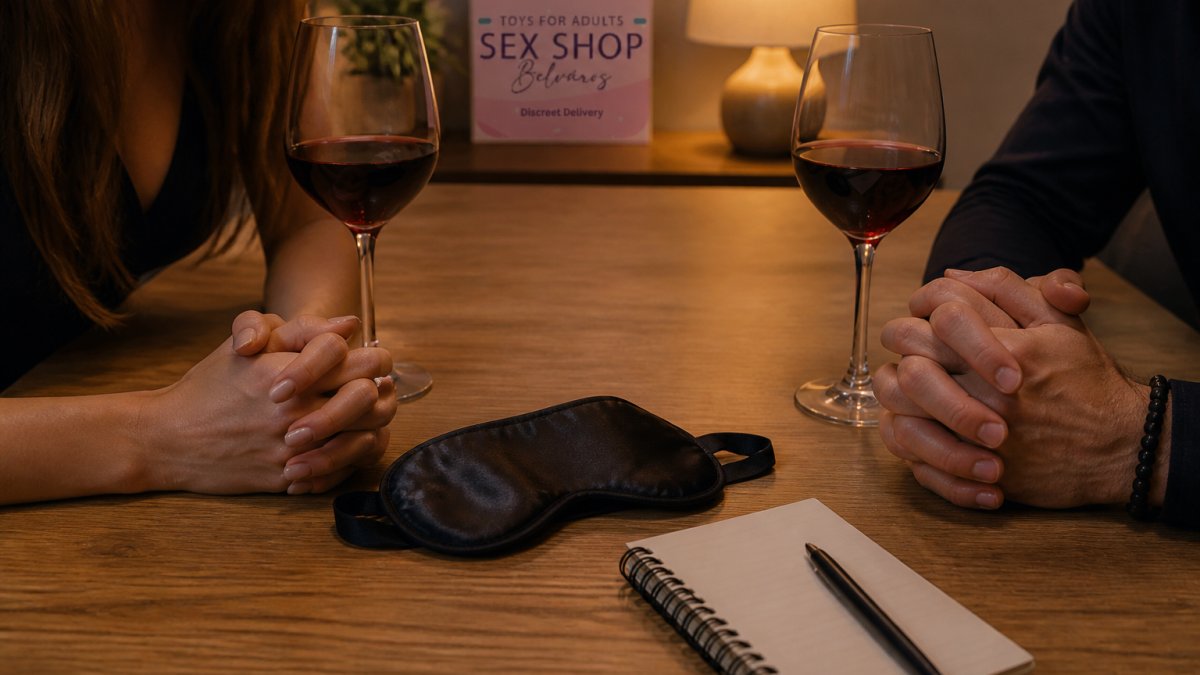
It's worth starting with these:
- An accessory or mask: A simple mask or accessory can instantly transform your role. Choose one that fits comfortably on your face and won't slip off during the scene.
- A costume or dress: An outfit that fits the role and that you both feel comfortable in. It's important that it's not tight and that you can move easily in it.
- A little mood lighting: This helps a lot to create a shared atmosphere. A simple, dimmed lamp is enough.
What should you look for when choosing accessories?
Beginners often make the mistake of choosing a spectacular piece, only to find that it is uncomfortable or difficult to handle during the scene. Here are some points to help you avoid this:
- Material: Leather-like materials (such as polyurethane) are easy to clean but less breathable. Textile-based pieces are more comfortable but more susceptible to stains. Choose according to the length of the scene and your comfort level.
- Size: Masks and costumes may vary in size, check the size chart and if you are unsure, choose the larger size because the looser piece is more comfortable.
- Cleaning: Most accessories can be hand washed in lukewarm water, but leather-effect pieces should only be wiped with a damp cloth. Always check the product description as different materials require different care.
- Compatibility: If you are using other props for the scene (such as handcuffs or restraints), make sure the materials and sizes of the pieces match and that the safety release is always accessible.
Caution: Leather-like materials are prone to stains, so if either of you has sensitive skin, choose a textile-based piece and clean it immediately after the scene.
What supplies should you buy first?
If you're just starting out, don't buy a whole wardrobe of costumes at once. Just one or two pieces are enough, which you can then vary for different roles.
- A neutral mask: This fits most roles and doesn't require a separate costume.
- A simple addition: For example, a tie, a scarf or a belt can create a different atmosphere.
- An easy-to-clean piece: For beginners, it's worth choosing one that can be wiped clean with a damp cloth.
If you want to see a selection, erotic clothing You can find pieces in our webshop.
What if one of you gets embarrassed or changes your mind?
This is completely natural. Many people feel a little awkward or suddenly don't want to continue with something the first time. The most important thing is not to force it.
- Stop. A break does not mean failure.
- Talk about it calmly. Tell me what's bothering you or why it's not working.
- Come back later or leave. Another time the mood might be different.
The best relationships are about both partners feeling safe. If someone changes their mind, it's not a sign of weakness, it's a sign of respect for boundaries.
Next step: choose an evening and an idea
Don't try everything at once. Pick a night, a short role-play idea, discuss the boundaries, and try it out. Then sit down and discuss what worked and what didn't.
If you feel like it, take a look around our webshop and choose a piece that fits your shared vision. The point is not to have the perfect scene, but to discover something new together.
Frequently asked questions
How do we get started with role-playing as a couple?
The best place to start is with a short, casual conversation, not a sudden idea. Sit down over an evening coffee or wine and both of you talk about 2-3 roles you would like to play and 1-2 things you would not like to play yet. Start with a simple, short scene, like a stranger at a bar, and let it develop as you play. The goal of the first time is to laugh together and be comfortable, not to have a perfect performance.
What role-playing ideas are good for beginners?
For beginners, short, easy-to-follow scenarios work best: the stranger at the bar, the visiting maid, or the neighbor who happens to knock. These don't require a complicated backstory and are easy to stop or rewrite at any time. Choose a role that you both feel comfortable playing, and the focus should be on the mood and conversation, not the flashy costume.
How to agree on boundaries before role-playing?
Before you start, discuss what is okay, what is not, and what you would like to try later. It is helpful to agree on a simple safe word or signal that either party can use at any time and the game stops immediately. Don’t assume the other person is sensing what you want; ask about role, tone, and pace.
What should we do if one of us gets embarrassed while playing?
It's perfectly normal to feel confused, especially the first time. When this happens, stop, laugh together, and say what's bothering you. It often helps to simplify the scene or switch roles. If someone is uncomfortable, the game can be moved to another scenario or a break can be taken. The important thing is to keep the game comfortable for your relationship afterwards.
